
Thailand’s Clean Air Act is stuck. The Senate’s version would cut maximum fines by 90%.
by Karl von Luckwald / October 19, 2026
Updated 18 October 2026
Three things to know:
- Thailand’s Clean Air Act is stuck in parliament. The House and the Senate passed different versions, and a committee of both now has to agree on one.
- The Senate’s version is much weaker. It cuts the top fine for factories that break emission standards from THB 50 million to THB 5 million, and removes several tools citizens could use.
- It won’t help this haze season. By our reading, no route puts the law in force before the haze season starts.
Thailand still has no dedicated clean air law
Thailand fights air pollution with older, general laws, such as the 1992 Environmental Quality Act. The Clean Air Act would be the first law built for the job. It sets up national and provincial clean air committees, a Clean Air Fund, rules for factories, vehicles and farmland, and fines for polluters (iLaw).
The push began with ordinary people. A citizens’ bill backed by more than 22,000 signatures was submitted in January 2022 (Mongabay, The Active).
The law is stuck between the House and the Senate
A law needs both the House and the Senate. Here is how the Clean Air Act got stuck:
- January 2022: citizens submit their bill. Six other drafts follow and are merged into one.
- October 2025: the House of Representatives passes the merged version.
- December 2025: parliament is dissolved before an election, and the bill dies.
- May 2026: the new parliament brings it back.
- July 2026: the Senate passes it, but rewrites dozens of sections.
- 2 September 2026: the House rejects the Senate’s version, 414 votes to 2 (Daily News).
- Now: a joint committee of 10 MPs and 10 senators has to agree on one text. We are here. We found no report of it meeting since the senators were named in mid-September.
Meanwhile, other countries are using their laws. On 16 October, Singapore served seven Indonesian companies with notices under its Transboundary Haze Pollution Act. That law lets Singapore fine companies abroad for smoke that reaches the city.
Change 1: the Senate would cut the top fine tenfold
A fine only works if it hurts more than polluting pays. Both versions keep the same prison terms. The difference is the maximum fine.
|
Offence |
House maximum fine |
Senate maximum fine |
Prison (both versions) |
|---|---|---|---|
|
Exceeding an emission standard |
THB 50 million |
THB 5 million |
Up to 2 years |
|
Ignoring an official’s order, or reoffending in a critical pollution area |
THB 100 million |
THB 10 million |
Up to 5 years |
House figures from The Standard; Senate figures as reported by AEC10NEWS. The official Senate text has not been published.
So how much is THB 5 million to a big company? Take a company with SCG’s 2025 sales of THB 496.9 billion. It takes in THB 5 million in about five minutes of revenue, and the House’s THB 50 million in under an hour (Kaohoon). We use SCG only as a yardstick for a large Thai manufacturer.
People’s Party MP Phattharaphong Leelaphat put it this way, as quoted by The Nation. “For a large factory, THB 5 million is a cost of doing business, not a punishment.”
Here is how the Senate’s figure compares:
|
Law |
Maximum fine |
|---|---|
|
Thailand today (Environmental Quality Act, 1992) |
THB 500,000 |
|
Thailand, Senate version |
THB 5 million |
|
Malaysia (Environmental Quality Act, amended 2024), air emissions |
RM 1 million, plus daily fines |
|
Thailand, House version |
THB 50 million |
|
Singapore (Transboundary Haze Pollution Act) |
S$100,000 per day, up to S$2 million |
Sources: Thai Environmental Quality Act, English translation (THB 500,000 is the highest fine in that 1992 text), Malaysia Act A1712, Singapore THPA and Shook Lin & Bok. These laws cover different offences, so treat the table as a sense of scale.
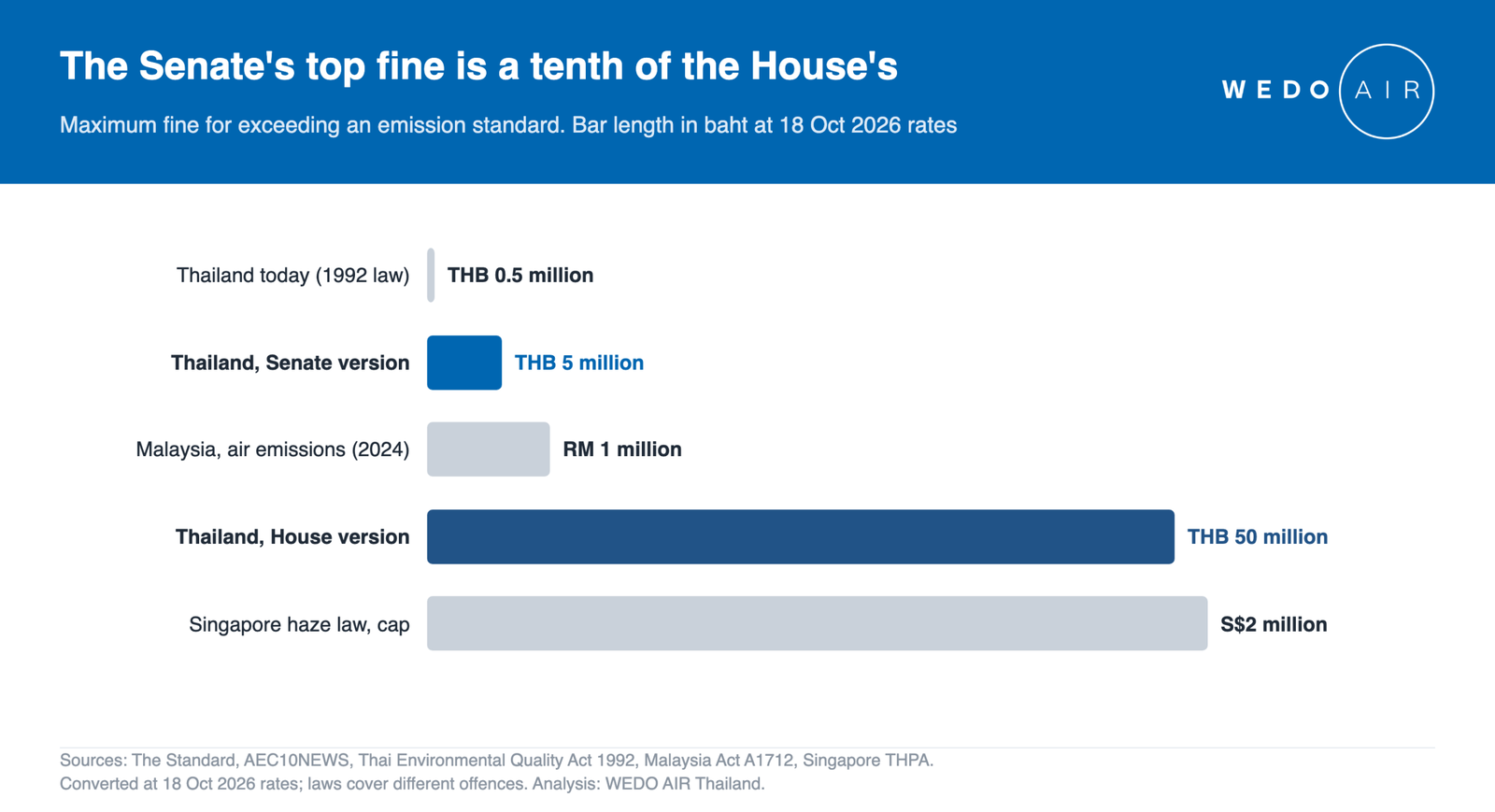
The Senate’s fine is still ten times today’s THB 500,000 ceiling. But it is smaller than Malaysia’s RM 1 million (about THB 8.2 million at 18 October 2026 rates). It also equals less than two days of Singapore’s daily maximum (about THB 2.6 million a day).
Change 2: the Senate removed tools that let citizens act
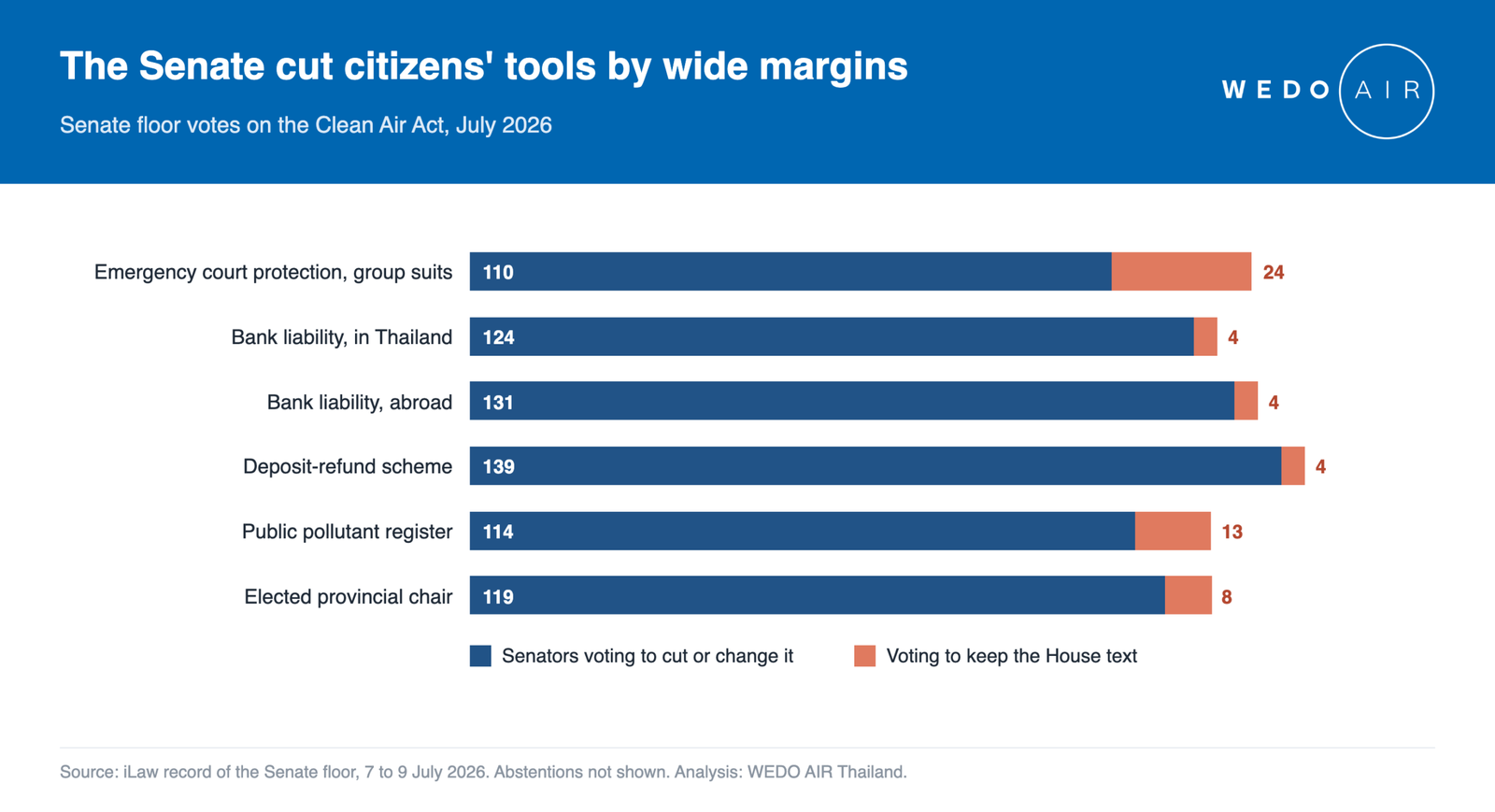
The fines got the headlines. The Senate’s floor votes, recorded by the legal watchdog iLaw, went further. For each tool below: what it would have done, and how the Senate voted.
|
Tool in the House version |
What it would have done |
Senate vote |
|---|---|---|
|
Emergency court protection |
Let citizens ask the administrative court to step in fast, and let private organisations sue on behalf of groups |
Deleted, 110 to 24 |
|
Bank liability |
Made banks that finance polluting projects share the blame, in Thailand and abroad |
Deleted, 124 to 4 and 131 to 4 |
|
Deposit-refund scheme |
Charged a deposit on high-pollution goods, paid back when the waste is handled properly |
Deleted, 139 to 4 |
|
Public pollution register |
Showed everyone what each factory releases |
Narrowed to “air release data”, 114 to 13 |
|
Elected provincial chair |
Put the elected head of the provincial administrative organisation in charge of the local committee |
Replaced by the appointed provincial governor, 119 to 8 |
The bank clause covered projects in control areas without proper risk checks. Some reports say it was kept; they describe the Senate committee’s report, which the full Senate then overruled. Pollution registers are not new: the US has run one since 1986, and at least 50 countries have one or a pilot (US EPA).
Courts can already act on air pollution. A Chiang Mai resident sued the National Environment Board. The Supreme Administrative Court then ordered the board to declare four northern provinces PM2.5 control zones from February to May each year (The Nation). We could not confirm the declaration has been published in the Royal Gazette. That case used existing court powers, which is the Senate majority’s argument for dropping the clause.
The Senate’s side says business needs time. Senate committee chair Wuttichat Kanlayanamit wants a six-month to one-year adjustment period. In May he warned that imposing everything at once would damage industry, but said firms that fail to adapt would not be accepted either (Khaosod). In November 2025, the Federation of Thai Industries’ president said it agreed with the law in principle. He questioned the method (The Standard).
We found no route that puts the law in force before the haze season
Thailand’s 2017 constitution sets the rules from here (sections 137 and 138). There are two ways forward:
- Both houses agree. If the House and the Senate both accept the joint committee’s version, the bill goes to the King for royal assent.
- The House goes alone. If either house rejects it, the bill is put on hold. After 180 days, the House can pass its own version with more than half of sitting MPs. If the bill counts as a “money bill”, meaning it deals with taxes or public money, the wait drops to 10 days. Parliament’s own TV channel has described it as one (TP Channel), but we have not seen a formal ruling.
By our reading, even the fastest path puts the law in force in early 2027. By then Bangkok’s PM2.5 season, roughly December to February, and northern Thailand’s burning season, roughly January to April, are already under way. The stakes are high. In 2024, the Ministry of Public Health counted 12.3 million people diagnosed with illnesses linked to air pollution, up 10.1% in a year (Asia News Network).
What you can do while the law waits
- Tell your MP which version you want. The joint committee’s report goes back to both houses for a vote.
- Read the PM2.5 number in the app. Thailand’s air rating calls many days “good” that are above the World Health Organization’s guideline, as our analysis of southern Thailand’s haze shows.
- Protect indoor air on bad days. Keep windows closed and run an air purifier with a HEPA filter, sized for the room. Our air purifier range covers homes and classrooms, and our guide to the best air purifier for wildfire smoke explains what to look for.
What comes next
The joint committee has no deadline. Its report must pass both houses, or the House must wait out the 180-day or 10-day period. If parliament is dissolved before then, the bill dies again, just as it did in December 2025.
Meanwhile, the haze season will arrive on schedule. For the north, the court order on control zones from February to May is the strongest legal tool on paper.
How we reported this. The official Senate-passed text has not been published. Clause numbers, vote counts and fine figures come from iLaw’s record of the Senate floor (7 to 9 July 2026) and Thai press reports. The THB 10 million figure rests on one outlet. Exchange rates are from 18 October 2026.
Using these figures? Please credit WEDO AIR Thailand and link to this page: wedo-air.com/blog/thailand-clean-air-act-senate.

Karl von Luckwald
Since moving to Thailand in 2019, Karl noticed the lack of scientific integrity in air purifier and water filter reviews. In response, he founded WE DO AIR to champion unbiased, science-based evaluations and empower consumers to make better-informed decisions.